
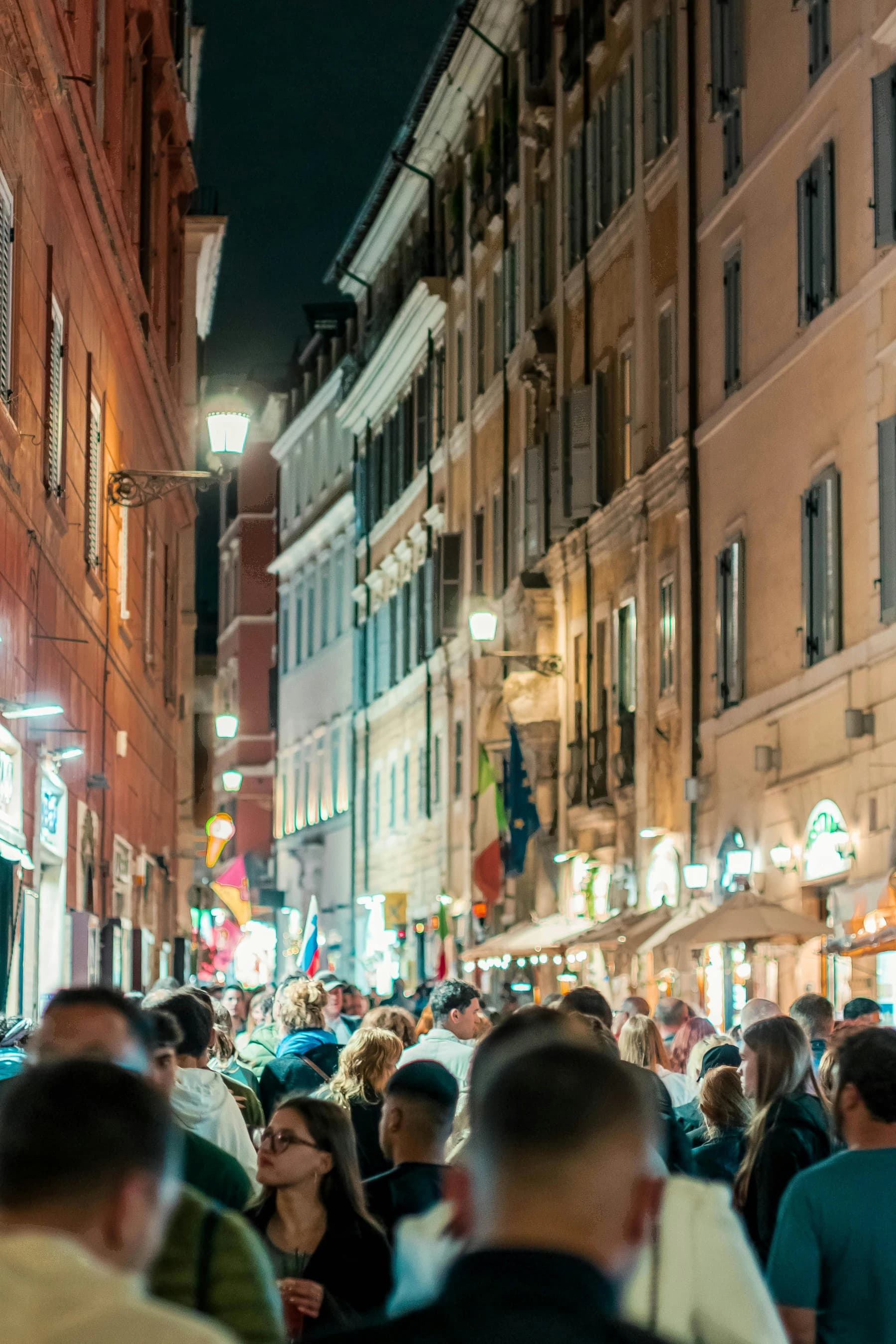
Last updated May 2026 · 14 min read
Quick Answer
6 zones worth knowing: Via Condotti (luxury), Monti (artisan / vintage), Via Cola di Rienzo (practical), Centro Storico (antiques), the markets (Porta Portese, Testaccio, Via Sannio), and the outlets south of Rome.
Short trip: go to Monti for the most concentrated independent shopping. Luxury flagships: Via Condotti. Outlets: Castel Romano (designer) or Valmontone (mainstream). Non-EU visitors can reclaim up to 15% VAT. See the VAT guide below.
Shopping in Rome rewards geography. The distance between a tourist leather shop near the Colosseum and a genuine artisan atelier in Monti is ten minutes on foot. The difference in quality and price is significant. Rome is not a global retail capital. It is a city of selective discovery, where what you buy and where you buy it shapes the experience entirely.
This guide covers every category: the luxury district for serious designer shopping, the independent neighborhoods for craft and vintage, the markets that still serve actual Romans, the outlet malls south of the city where real discounts exist, and a detailed section on the VAT refund, including the passport rule that most guides omit.
Think of Rome's shopping zones the way you think of its neighborhoods: each one is a different version of the city. Via Condotti is luxury Rome. Monti is artisan Rome. Porta Portese on Sunday morning is Roman Rome. The best shopping day is the one that weaves them naturally into movement rather than treating them as a dedicated afternoon block. More on that in the timing section.
Rome shopping zones at a glance
| Zone | Vibe | Best for | How to get there |
|---|---|---|---|
| Via Condotti | Italian luxury flagships | Prada, Gucci, Bulgari, VAT refund purchases | Metro A → Spagna (2 min) |
| Monti | Independent, artisan, vintage | Leather ateliers, ceramics, vintage, jewelry | Metro B → Cavour (5 min) |
| Via Cola di Rienzo | Practical, local, no tourist markup | Italian chains, food shops, kitchen | Metro A → Ottaviano (5 min) |
| Centro Storico | Antiques, books, prints | Via dei Coronari, rare maps and prints | Walk from Pantheon / Navona |
| Markets | Sunday flea, food, vintage | Porta Portese, Testaccio, Via Sannio | Tram 8 (Portese); Metro A San Giovanni (Sannio) |
| Castel Romano | Designer outlet, ~30 min south | Prada, Gucci, Armani at 30–50% off | McArthurGlen shuttle from Termini/EUR Fermi, or private car |
| Valmontone | Mainstream outlet, ~45 min SE | Nike, H&M, Tommy, up to 70% off | Car via A1 or regional train to Valmontone |
Via Condotti & the Golden Triangle
Via Condotti is Rome's luxury axis. Running from the Spanish Steps down to the Piazza di Spagna area, it is where Gucci, Prada, Fendi, Bulgari, Valentino, Ferragamo, Cartier, and most of the major Italian houses have their flagship stores. The “Golden Triangle” is the district framed by Via Condotti, Via Borgognona, and Via della Croce, a dense concentration of designer retail on a small footprint.
The pleasure here is comparison and concentration, not discovery. Prices are broadly comparable to other European capitals, sometimes marginally better than in Northern Europe. The main financial argument for shopping here is the VAT refund: as a non-EU visitor, you can reclaim 12–15% on purchases over €154.94 at a participating store, which meaningfully changes the effective price on a serious purchase. See the VAT guide below.
Via del Babuino, running north from Piazza di Spagna toward Piazza del Popolo, is the more interesting street for browsing: antique dealers, design showrooms, and contemporary galleries sit alongside upscale boutiques. Worth walking if you're already at the Spanish Steps.
Best for: Luxury flagship shopping, Italian designer pieces, serious VAT refund purchases.
How to get there: Metro A to Spagna: the station exits directly onto Piazza di Spagna at the base of the Spanish Steps. From the Centro Storico, about 20 minutes west along Via del Corso on foot.
Practical note: Pickpockets work the Spanish Steps area during peak hours. Keep bags fronted, wallets in a breast pocket.
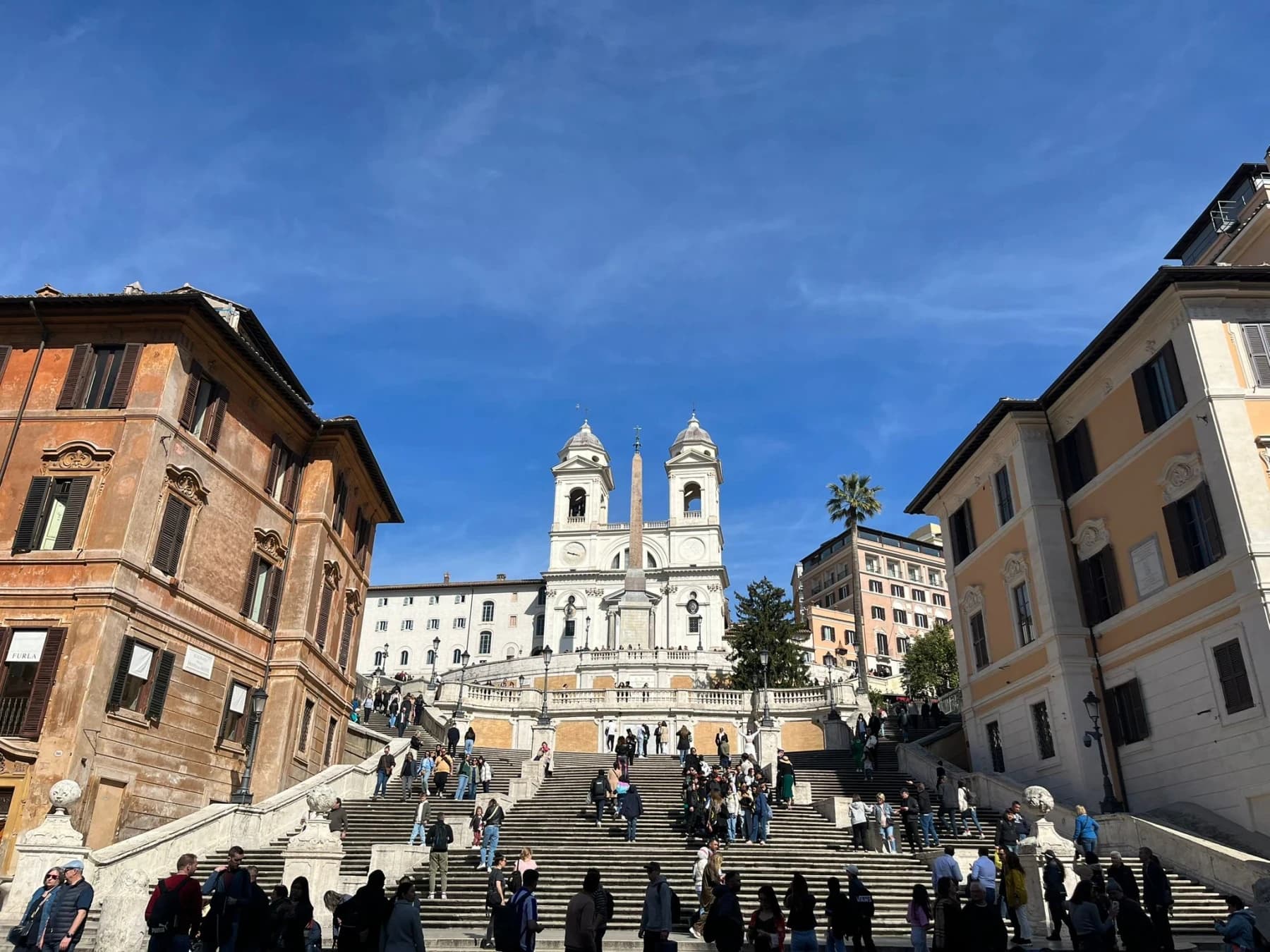
Piazza di Spagna, the anchor of Rome's luxury district. Metro A Spagna brings you directly here.
Monti: The Best Independent Shopping in Rome
Monti is where I point visitors when they want to shop rather than just buy. It is the most concentrated area of genuinely independent retail in Rome: small leather ateliers on Via del Boschetto, handmade jewelry studios, ceramic boutiques, curated vintage, and owner-operated workshops. The shops are not designed for tourists. They just happen to appeal to people who want something that isn't mass-produced.
Start on Via del Boschetto. Walk the full length before buying anything. The best pieces are not always in the most prominent windows. Quality varies by shop. The streets around it (Via dei Serpenti, Via Leonina, Via della Madonna dei Monti) extend the same character and are worth covering.
On weekends, Mercato Monti runs inside the neighbourhood's main event space (typically the RomaC in Via Leonina). It is a curated vintage and independent designer market (clothing, accessories, ceramics, small design objects), not a flea market. The selection is edited, the quality consistent, prices marked and fair. Worth an hour Saturday morning before the afternoon crowds arrive.
Best for: Leather accessories, ceramics, independent fashion, curated vintage, handmade jewelry, gifts that feel genuinely Roman.
How to get there: Metro B to Cavour, then 5 minutes on foot toward Via del Boschetto. Or 10–15 minutes walking north from the Colosseum, 20 minutes east from the Pantheon.
Routing tip: Monti pairs naturally with the Ancient Rome circuit: morning at the Forum, then a slow walk through Monti for lunch and browsing. We build this into the 2-day and 4-day itineraries.
Via Cola di Rienzo: Where Romans Shop
Via Cola di Rienzo in Prati is an underused asset for visitors who want Italian retail without the tourist premium. It is a practical commercial street (Italian chains, independent alimentari, kitchen supply shops, wine merchants) serving actual residents of the neighbourhood. No tourist performances, no inflated pricing, no souvenir racks.
The food shopping here is strong. Alimentari and delis on the side streets stock the pantry items worth taking home: aged pecorino romano, guanciale, proper pasta, olive oil in sealed tins. Prices are neighbourhood prices, not tourist prices.
The practical reason to include it: Via Cola di Rienzo falls naturally between the Vatican and a metro stop heading back toward the Centro Storico. Finish a Vatican morning, walk north through Prati, browse slowly, eat lunch, catch the metro at Ottaviano. Shopping becomes part of the movement rather than a dedicated detour.
Best for: Food souvenirs, practical Italian retail, kitchen supplies, no tourist markup.
How to get there: Metro A to Ottaviano (5 min walk), or walk from St. Peter's Square (15 minutes north through Prati).
Centro Storico: Antiques, Prints, and Books
Most shopping immediately adjacent to Campo de' Fiori, Piazza Navona, and the Trevi Fountain is not worth engaging with seriously. The exception is two specific areas within the Centro Storico that reward careful attention.
Via dei Coronari is Rome's antique street. Running from Piazza Navona toward the Tiber, it is lined with serious dealers in furniture, decorative objects, prints, and maps. The quality is high, the dealers are knowledgeable, the prices reflect both. This is not casual browsing. If antiques or original prints are a priority, this is the street.
Pantheon area print vendors concentrate in the streets running toward Largo Argentina. Antiquarian booksellers and vendors of 16th–19th century engraved city maps and botanical prints occupy small shops that are easy to miss. Original prints are not cheap but they are original. Ask for provenance and check for the plate mark: a slight depression around the image from the copper plate.
How to get there: Walking: it is the Centro Storico. Tram 8 from Trastevere drops close to Largo Argentina.
Trastevere: Side-Street Browsing
The main commercial streets of Trastevere have become tourist-facing. The side streets off Via della Lungaretta, around Piazza Piscinula, and the upper neighbourhood toward Piazza dei Mercanti still carry some genuine craft shops (ceramics, paper goods, small leather pieces) that haven't been optimised for passing visitors.
Worth an hour of browsing if you are already in the neighbourhood. Not worth a dedicated trip for shopping alone. The exception is Sunday morning: Porta Portese starts near here, and a Porta Portese visit before the Trastevere neighbourhood quiets down makes a strong Sunday morning combination.
How to get there: Tram 8 from Largo Argentina (3 stops); 20–25 min walk from the Pantheon via the Tiber.
The Markets: Sunday Flea, Food, and the Finds Most Visitors Miss
Rome has several distinct market types and they serve different purposes. Most visitors know Porta Portese. Almost none know Via Sannio or Piazza Vittorio. Understanding the difference between a flea market, a neighbourhood street market, and a covered food market changes what you get out of each.
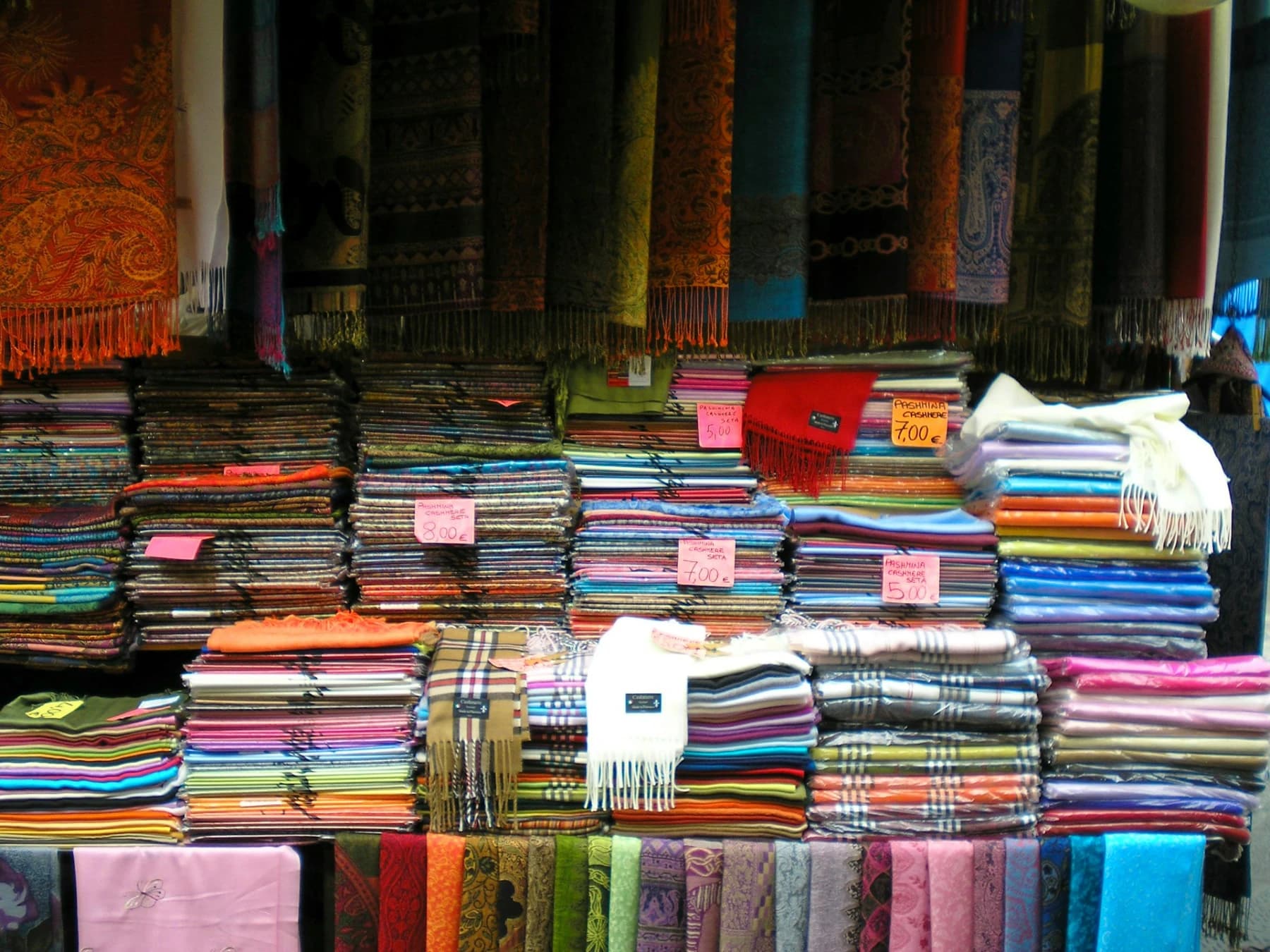
A Rome street-market stall, priced by hand. The markets are where the browsing and the bargaining happen.
Porta Portese: Sunday flea market
The big one. Porta Portese runs every Sunday along the Trastevere riverbank from approximately 6am to 2pm. Large, sprawling, and selling everything: clothes, furniture, tools, records, books, ceramics, jewellery, electronics. The quality varies enormously and bargaining is expected.
Arrive by 7:30–8am for the best selection and manageable crowds. By 10am on a summer Sunday it is packed. The serious antique sellers and dealers with quality items are in the first stretch toward the Porta end; the deeper you go, the more general the merchandise becomes. The Sunday in Rome guide covers how to build a morning around it.
How to get there: Tram 8 from Largo Argentina to Porta Portese / Trastevere stop, then walk toward the river. Or bus 23 along the Lungotevere.
Borghetto Flaminio: Sunday antiques, covered
A more curated antique market than Porta Portese, running Sunday mornings near Piazza del Popolo inside a covered structure. Furniture, ceramics, prints, and objects at serious prices. Better for antiques specifically; the covered format is more comfortable in summer heat or light rain. Hours roughly 10am–6pm.
How to get there: Metro A to Flaminio (3 min walk to Piazza del Popolo).
Via Sannio: vintage clothes and leather (Mon–Sat)
Near San Giovanni in Laterano, Via Sannio is a neighbourhood street market most visitors never find. It runs Monday through Saturday and specialises in cheap vintage clothes, leather goods, and workwear. The kind of place where Romans buy a leather belt or a second-hand jacket. Prices are the lowest in the city for this category. It is not curated, not pretty, and that is exactly the point.
How to get there: Metro A to San Giovanni (5 min walk south toward Via Sannio).
Mercato di Testaccio: food (Mon–Sat)
The most reliable source for edible souvenirs in Rome. The covered market runs Monday through Saturday and is still primarily a neighbourhood food market: aged pecorino romano, guanciale, cured meats, seasonal produce, artisanal pasta, olive oil. Buy from the perimeter vendors for pantry items; the central food boxes are for eating on the spot.
Best time: 8:30–11am, while it is fully running but still feels like a neighbourhood routine rather than a lunch crowd. For a full morning guide, see Morning in Testaccio.
How to get there: Tram 3 from Colosseo to Testaccio; bus 23 or 75 from Centro Storico; Metro B to Piramide (15 min walk). Testaccio has no direct metro stop.
Mercato di Piazza Vittorio: everyday, multicultural
Piazza Vittorio Emanuele II in the Esquilino neighbourhood has a large covered daily market with a genuinely multicultural character. One of the few markets in Rome that reflects the city as it actually is. Honest prices, no tourist performance, and a good option if you are staying near Termini.
How to get there: 10 min walk east of Termini; or tram 5/14 from central Rome.
Testaccio food market tour
PartnerMarket stalls, pasta, and local produce with a guide based in the neighbourhood.
Day Trips: The Outlets Near Rome
Two outlet malls are within 45 minutes of Rome and serve completely different buyers. Castel Romano is for luxury at discount. Valmontone is for mainstream brands at serious reduction. Visiting either as a day trip is straightforward with a car, and significantly less straightforward without one.
McArthurGlen Designer Outlet Castel Romano
Castel Romano sits on Via Pontina (SS148), approximately 25–30 km south of Rome. It is a proper designer outlet: Prada, Gucci, Burberry, Versace, Armani, Fendi, Tod's, and roughly 130 stores across the upscale spectrum, with discounts typically running 30–50% off standard retail. If you are buying a €1,200 bag, the saving is meaningful. If you are looking for a €30 t-shirt, this is not your destination.
Getting there: the official McArthurGlen shuttle is the budget option, running from Termini (Via Giolitti 48) and from EUR Fermi. Round trip is roughly €18 from Termini and €13 from EUR Fermi, free for children under 10, and no reservation is needed. Trenitalia also sells a combined “Castel Romano Link” train-and-bus ticket, and showing a valid ticket at the entrance earns a Fashion Passport card worth an extra 10 percent in the shops. Confirm current times before you go, since they change with the season.
The alternative is a private car with a driver: door-to-door from your hotel, driver waits while you shop, return to Rome on your schedule. It costs more than the shuttle but removes the queue, which matters most on the ride back with a full day of bags behind you. It is designed for airport transfers but equally useful for outlet day trips.
Private car to Castel Romano outlet
Door-to-door from your Rome hotel. Driver waits while you shop, return whenever you’re done.
Worth it? Yes, for anyone planning serious luxury purchases. The Prada and Gucci discounts are real. Non-EU visitors can layer the VAT refund on top of the outlet discount. Bring your passport to the stores so they can issue the Tax Free form at point of purchase.
Opening hours: generally 10am–8pm (extended in peak season). Check McArthurGlen for current hours and brand availability before going.
Valmontone Outlet
Valmontone is approximately 40 km southeast of Rome via the A1 motorway, about 45 minutes by car. It serves a completely different buyer: Nike, Adidas, H&M, Tommy Hilfiger, Calvin Klein, Levi's, and 180+ stores with discounts up to 70% on sportswear, casual fashion, and mainstream accessories.
Getting there: A car is the most practical route (A1 south to the Valmontone exit). A regional train from Roma Termini to Valmontone station runs periodically. Check Trenitalia for the current timetable before planning around it. The station is about 1.5 km from the outlet, walkable or a short taxi ride.
Worth it? Yes for budget-conscious shoppers, families, and anyone after serious volume discounts on sportswear and casual fashion. The scale (180+ stores) means allowing 3–4 hours to cover it properly.
Private car for outlet shopping
Car and driver to Castel Romano or Valmontone, timed around your shopping day.
What's Actually Worth Buying in Rome
Not everything sold as Italian in Rome is Italian, and not everything Italian is craft. These are the categories where quality genuinely holds.
Leather goods
Italy has a genuine leather tradition, but it concentrates more in Florence than Rome. In Rome the distinction is entirely about location. Via Condotti carries the major luxury houses. For independent artisan work, Monti is more interesting. There are small ateliers on Via del Boschetto where you can watch production and ask where the piece was made. A real answer means a real product. Evasion usually means China by way of a Roman label.
What to avoid: leather goods from stalls around the Colosseum, Trevi Fountain, or Borgo Pio near the Vatican. The proximity premium is real and quality drops in direct proportion to foot traffic density.
Ceramics
Hand-painted ceramics are a legitimate Roman purchase when sourced correctly. Look for: irregular glaze, slight asymmetry from hand work, painted detail that does not repeat perfectly. Avoid: anything uniform, anything packaged for volume, anything in tourist corridors. The best pieces come from shops in Monti or from importers that work directly with Deruta and Vietri producers. If it is very cheap, it was made in a factory.
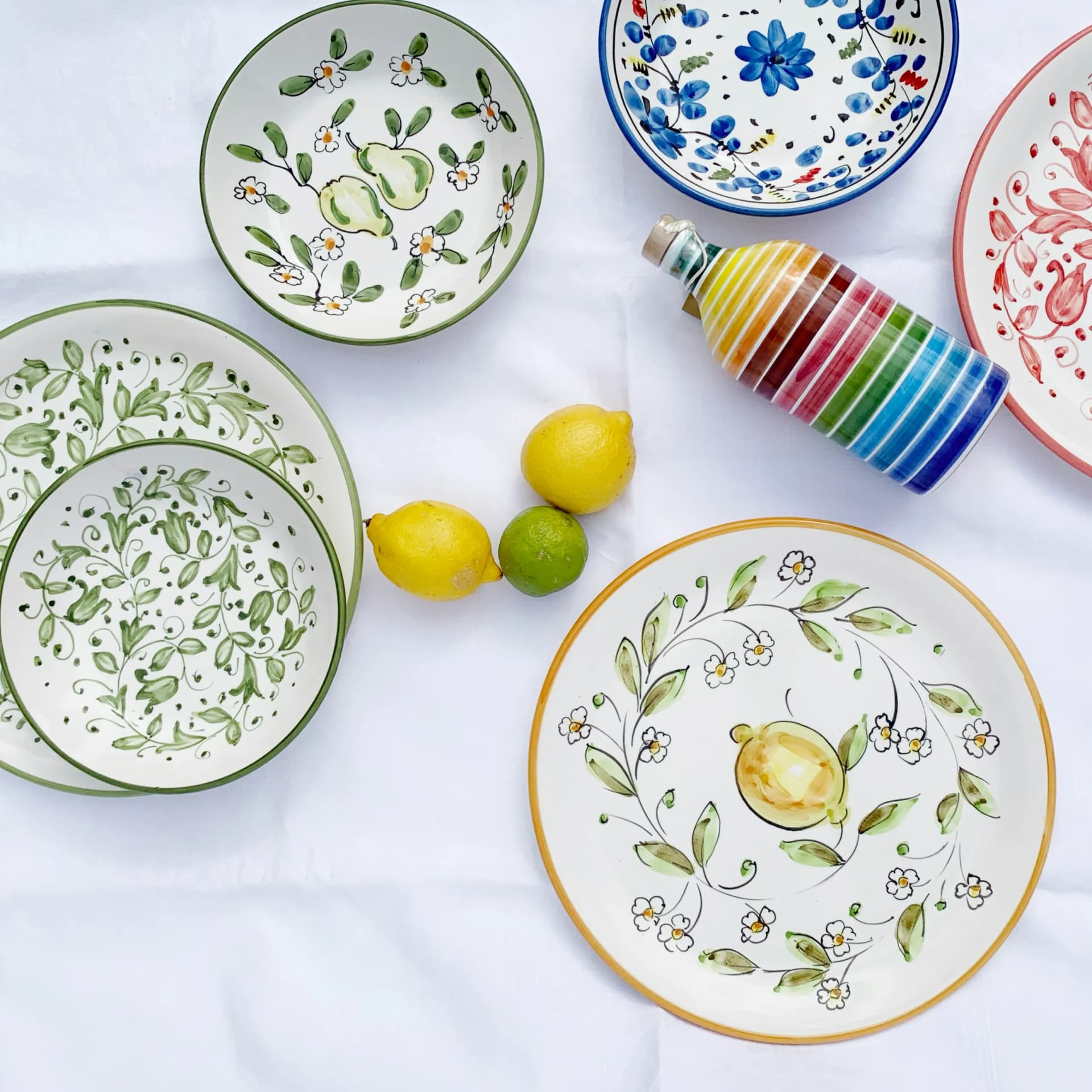
Hand-painted majolica. Look for irregular glaze and slight asymmetry, the marks of real handwork rather than factory output.
Food products
The most reliable category. Food travels well, has clear provenance, and costs a fraction of what you would pay for equivalent quality at home. Worth taking back: aged pecorino romano from a proper alimentari, guanciale or 'nduja from a salumeria, artisanal dried pasta, high-quality olive oil in a sealed tin, regional wines that do not export widely. Testaccio Market and Mercato Trionfale are the most reliable sources.
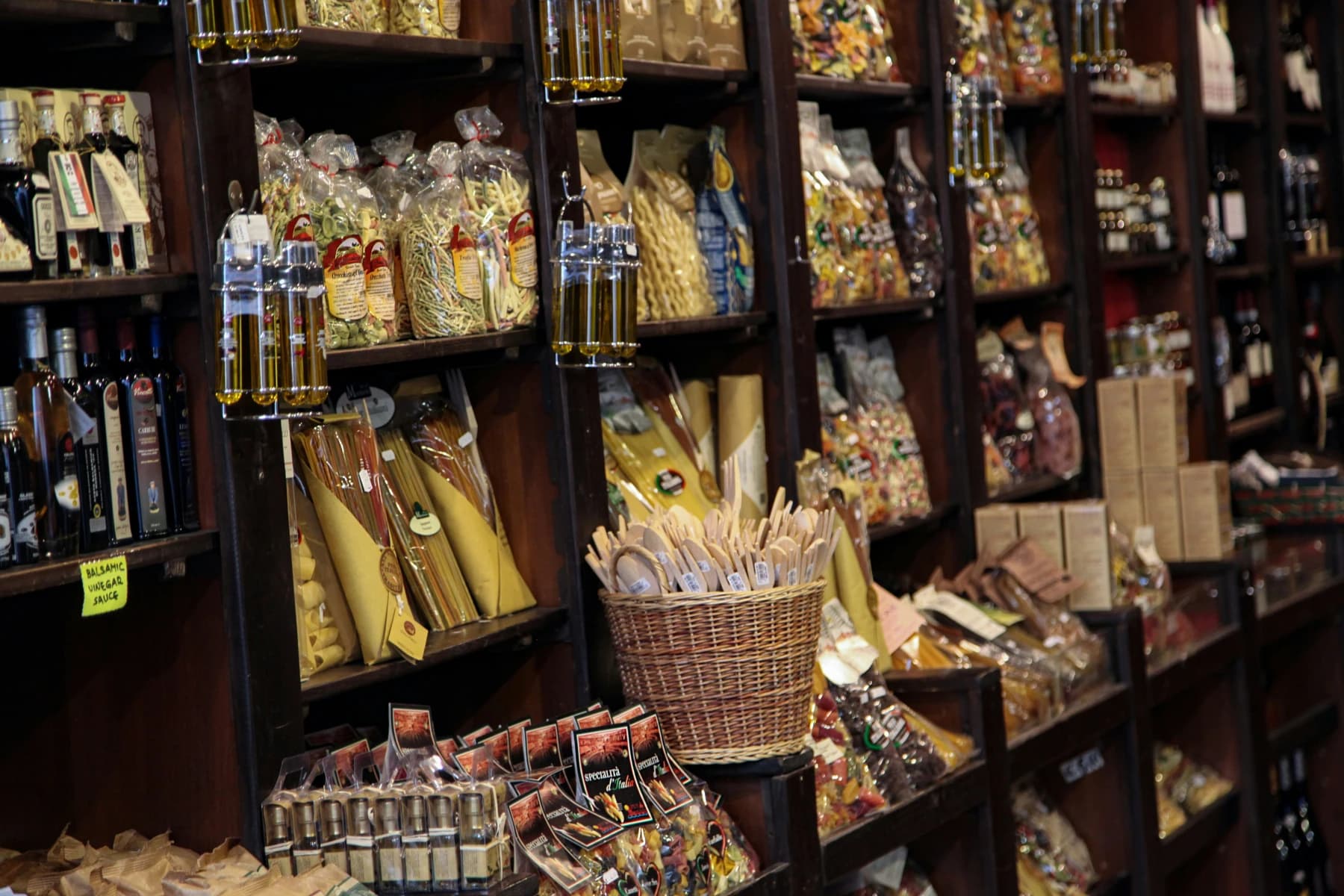
A Roman alimentari. Pasta, oil, and preserves that travel home far better than anything from a monument-side stall.
Avoid the bulk truffle products sold near every monument. The truffle content is usually negligible and the oil is industrial. If truffle is genuinely what you want, buy from a specialist.
If food shopping is a priority, see the restaurants guide. Testaccio rewards a morning market visit followed by lunch at one of the neighbourhood's trattorias.
Lazio wine and food tasting
PartnerPDO wines, local cheeses, and cured meats with a guide.
Books, prints, and maps
Antique map sellers and print vendors cluster in the Centro Storico near the Pantheon, along Via dei Coronari, and in the streets toward Largo Argentina. 16th–19th century engraved city views and botanical prints are available; they are not cheap but they are original. Check for the plate mark: a slight depression around the image confirms it was made from a copper plate, not a photographic reproduction.
VAT Refund: How to Get Your Money Back
Non-EU visitors can reclaim Italian VAT (roughly 12–15%) on purchases over €154.94 at a single store in a single transaction. On an €800 bag, that is €100–120 back. On a €2,000 coat, the saving is substantial. Most serious retailers participate: Via Condotti flagships, Castel Romano outlet stores, department stores.
Critical: Passport Required at the Till
The store cannot issue the Tax Free form without seeing your original passport at the time of purchase. Not a photo on your phone. Not a driving licence. Not a photocopy. Your actual passport must be physically present when you pay.
If you do not have it with you when you pay, the store will not issue the form and you lose the refund on that purchase entirely. There is no retroactive option once you leave the shop.
The full process
- At the store: show your passport and ask for the Tax Free form (Global Blue or Planet Tax Free). The store completes and stamps it.
- At the airport: customs stamp FIRST, before bag drop: Go to the customs desk before you check in your luggage. The customs officer needs to see both the goods and the Tax Free form. Once your bags are checked in, you cannot retrieve them for customs inspection. This mistake is permanent.
- Airside: collect the refund: After clearing security, find the Global Blue or Planet Tax Free kiosk airside. Cash refunds (euros, minus a small processing fee) are immediate. Card refunds take a few weeks and carry a processing fee.
Getting your refund inside Rome
For visitors who prefer not to deal with the airport queue: La Rinascente (Via del Tritone) has a Global Blue refund desk where you can collect your refund in cash before leaving Rome. The customs stamp is still required before going to the desk. Some other participating retailers offer the same service; ask at the shop when you make the purchase.
Common mistakes
- Multiple smaller receipts: Each transaction must individually exceed €154.94. Splitting a €300 purchase into two receipts at the same store loses you the refund entirely.
- Forgetting the customs stamp before bag drop: The most common error. Once bags are checked in, there is no way to retrieve goods for customs inspection. Customs stamp first, always.
- Card refund processing fees: Card refunds carry a processing fee that reduces the amount. Cash airside gives you more but requires euros on hand.
- Buying at non-participating stores: Market stalls, most small street vendors, and many small neighbourhood shops do not participate. Tax Free shopping applies primarily at boutiques, department stores, and flagship retailers.
Sunday, August, and How to Time Your Shopping
Most independent shops in Rome are closed on Sunday. Many are also closed Monday morning, a holdover from the traditional Italian schedule that still applies across much of small retail. If Sunday shopping matters, markets are your reliable option: Porta Portese on Sunday morning, Borghetto Flaminio for antiques. See the Sunday in Rome guide for what else stays open.
August is unreliable. Many family-run shops close for 2–3 weeks in the middle of the month. If shopping is a meaningful part of your trip, August is the wrong month.
How to time the day
- 7:30–9am: Markets (Porta Portese, Testaccio). They start well and close early. Do not leave them to the afternoon.
- 10am–1pm: Artisan browsing: Via del Boschetto in Monti, Via dei Coronari, Prati food shops.
- 3–7pm: Luxury district and boutiques. Designer flagships on Via Condotti in the late afternoon have less crowd pressure than midday.
- Outlet day trips: Leave Rome by 9am to reach Castel Romano or Valmontone before the midday rush. Allow 3–4 hours at either location.
Bargaining is not the culture in Rome. Established shops and designer boutiques work on fixed prices. Bargaining makes sense at Porta Portese and small antique markets, not in serious artisan stores or boutiques.
Where Romans actually shop: the city's malls
Rome's historic center is boutiques, artisan workshops, and the flagship strips around Via del Corso and the Condotti. But the shopping Romans do on a Saturday happens at the edges of the city, in full-size malls most visitors never hear about (for the designer outlets, see the outlets section above). If you want air conditioning, a food court, familiar brands, and prices that are not set for tourists, these are worth the trip out. Here is where to go and how to reach each one.
Euroma2, in the EUR district
The most polished indoor mall inside the city, set among the wide rationalist streets of EUR south of the center. Around 230 shops across three levels, a large supermarket on the bottom floor, a food court at the top, and an aquarium if you have children to keep busy. Prices run mid-range, mostly Italian and international chains, no tourist stalls.
Getting there: take Metro Line B toward Laurentina and get off at EUR Fermi. From the lower level of the station, catch bus 070 or 700 to the Colombo/Pacifico stop, then walk about five minutes. The whole trip from the center runs 30 to 40 minutes.
Porta di Roma
A vast mall on the northern edge of the city, anchored by big-format stores including IKEA. Good if you want everything under one roof without leaving Rome proper. Less designer, more everyday.
Getting there: the 38 bus from Termini, or the 80 from Piazza Venezia, to the Bene/Lionello stop. Budget about an hour each way. The ride is long but simple, with no changes.
One more, for your flight day: Parco Leonardo
If you are flying out of Fiumicino, the Parco Leonardo mall sits one stop before the airport on the FL1 regional line, with its own station of the same name. Trains run from Termini, Tiburtina, Ostiense, and Trastevere. It is an easy way to spend a few unhurried hours near the airport instead of sitting at the gate.
Getting there is easy. Getting back with your bags is the part to plan.
Going out is simple: a metro ride or a shuttle, light on your feet, a few euro. Coming back is where a mall trip turns tiring, standing on a hot platform or waiting in a shuttle queue with four heavy bags and a full day already behind you. The Castel Romano queue in particular can run long in the late afternoon, when everyone leaves at once.
So plan it in halves. Take public transport out, when you are fresh and carrying nothing, and book a private car for the ride home. A driver meets you at the entrance, the bags go in the boot, and you are back at your apartment door in around half an hour with nothing to carry up the metro steps. For a designer-outlet haul or a family shop, it is the difference between ending the day well and ending it worn out.
Want a car waiting when you are done?
Tell us your mall and your timing and we will arrange a private pickup.
Questions About Shopping in Rome
What is the best shopping street in Rome?
It depends on what you are looking for. Via Condotti and the Piazza di Spagna area are the right choice for luxury flagships — Gucci, Prada, Fendi, Bulgari. Via del Boschetto in Monti is the best street for independent artisan shopping: small leather ateliers, ceramics, curated vintage, and handmade jewelry. For practical Italian retail with no tourist markup, Via Cola di Rienzo in Prati is the most useful.
Are there outlets near Rome worth visiting?
Yes, two distinct ones. McArthurGlen Designer Outlet Castel Romano is about 25-30 km south on Via Pontina: Prada, Gucci, Armani, Versace at 30-50% off. Valmontone Outlet is about 40 km southeast via the A1: Nike, Adidas, H&M, Tommy Hilfiger, 180+ stores with discounts up to 70%. They serve different buyers — Castel Romano for serious luxury purchases, Valmontone for casual and sportswear.
How do I get to Castel Romano outlet from Rome?
Two ways. The official McArthurGlen shuttle is the budget option, running from Termini (Via Giolitti 48) and EUR Fermi, round trip roughly 18 or 13 euros, free for under-10s, no booking needed. A private car with driver is the door-to-door alternative: pickup at your hotel, the driver waits while you shop, and you return on your own schedule with no shuttle queue, which matters most on the ride back with bags.
Do I need my passport to get a VAT refund in Italy?
Yes — and you need the actual physical passport at the till at the time of purchase. Not a photo on your phone, not a driving licence, not a photocopy. The store cannot issue the Tax Free form without seeing the original document. If you do not have your passport with you when you pay, you lose the refund on that purchase entirely.
Can I get my VAT refund within Rome before going to the airport?
Yes. La Rinascente (Via del Tritone) has a Global Blue refund desk where you can collect your refund in cash before leaving Rome. The customs stamp is still required first, but you avoid the airport queue. Some other participating retailers offer the same — ask the shop at the time of purchase.
Is shopping in Rome possible on Sunday?
Markets, yes. Most shops, no. Porta Portese is the big Sunday flea market — it runs every Sunday morning along the Trastevere riverbank from about 6am to 2pm. Borghetto Flaminio is a smaller, curated antique market near Piazza del Popolo also running Sundays. Independent boutiques and most small shops are closed on Sunday.
What is Porta Portese?
Porta Portese is Rome's main Sunday flea market, running every Sunday morning along the Trastevere riverbank from approximately 6am to 2pm. It is large and eclectic: clothes, furniture, records, ceramics, jewellery, tools, books. Arrive by 7:30-8am for the best selection and manageable crowds. The serious antique dealers are at the Porta end; the further in you go, the more general the merchandise becomes. Bargaining is expected.
What is the best market in Rome for food souvenirs?
Mercato di Testaccio (Monday-Saturday) is the most reliable source for edible souvenirs in Rome. Go in the morning, buy from perimeter vendors rather than the central food boxes, and focus on aged pecorino romano, guanciale, cured meats, artisanal pasta, and olive oil in sealed tins. Prices reflect a working neighbourhood market, not a tourist market.
Can I bargain in Rome shops?
Not in established shops or boutiques — prices are fixed. Bargaining is normal and expected at Porta Portese and smaller antique or flea markets. At Mercato Monti (the curated vintage market in Monti), prices are marked and not typically negotiable. The rule is: the more serious and established the shop, the more fixed the price.
What should I avoid buying near Rome's main landmarks?
Avoid leather goods, ceramics, truffle products, and generic souvenir items sold from stalls directly around Trevi Fountain, the Colosseum, and Borgo Pio near the Vatican. The convenience premium is high and quality drops in direct proportion to foot traffic density. Made in Italy on a label is not a guarantee — it means final assembly happened in Italy, not that the product was crafted there.
What is the best shopping mall in Rome for tourists?
For designer brands at a discount, Castel Romano Designer Outlet, about 25 km south with its own shuttle from Termini. For a full modern mall inside the city, Euroma2 in EUR. Castel Romano is the one most visitors from the US picture when they think of outlet shopping.
How do I get to Euroma2 from central Rome?
Take Metro Line B toward Laurentina to EUR Fermi, then bus 070 or 700 to the Colombo/Pacifico stop, about a five-minute walk from there. Roughly 30 to 40 minutes door to door.
How do I get to Castel Romano Designer Outlet without a car?
The official McArthurGlen shuttle leaves from Termini (Via Giolitti 48) and from EUR Fermi, round trip roughly €18 or €13, free for under-10s, no booking needed. Trenitalia's combined "Castel Romano Link" ticket is an alternative and comes with a 10 percent discount card at the entrance.
Is it worth taking a private car back from the mall?
If you are carrying a lot or traveling with family, yes. Public transport out is cheap and easy when your hands are free. The trip back, loaded with bags at the end of a long day, is where a private car earns its cost, especially from Castel Romano, where the afternoon shuttle queue can be slow.
This page contains affiliate links. If you book tickets or services through these links, we may earn a small commission at no extra cost to you. We only link to providers we would recommend regardless.
Related reading
- Morning in Testaccio: Rome's Best Local Market
- What to Do in Rome on Sunday
- Best Restaurants in Rome by Budget
- Where to Stay in Rome: Best Neighborhoods
- Private Car with Driver: Airport Transfer & Day Trips
Related Services
Ways we can help with this trip
Personalized itineraries
Day-by-day Rome plans built around timing, geography, and the way you actually travel.
Explore itineraries →Experiences
Bookable Rome services (transfers, restaurant reservations, planning calls, car with driver) plus curated evenings, cooking classes, and day trips.
See experiences →Airport transfer
Fixed-rate pickup from FCO or Ciampino with meet and greet inside arrivals.
Book airport transfer →Stay in Testaccio
A two-bedroom apartment in Testaccio for travelers who want a local base without losing city access.
View the Testaccio stay →