
Last updated Apr 2026 · 10 min read
There is a neighborhood in central Rome that most first-time visitors walk past without stopping. It sits between Campo de' Fiori and the Tiber, roughly ten minutes on foot from either. Its streets are narrow, its buildings old even by Roman standards, and on a Friday afternoon you can hear Hebrew spoken at the tables outside the restaurants on Via del Portico d'Ottavia.
This is Rome's Jewish Quarter, home to the oldest continuous Jewish community in Europe. Not the oldest in Italy. In Europe. Jews have lived in this part of the city since at least the second century BCE, centuries before Christianity existed as a religion. The neighborhood has been walled, flooded, raided, and mourned. It has also survived all of it, and the result is one of the most historically dense and culinarily specific places in Rome.
If you are spending more than two days in the city, it deserves a morning.
A short history worth knowing
Jews arrived in Rome as traders and diplomats long before the Common Era. By the time of Julius Caesar, who reportedly passed protective legislation for the community, tens of thousands were living along the Tiber. Caesar's death was mourned by the Jewish community for several nights at his funeral pyre, a detail Roman historians recorded with apparent surprise.
In 1555, Pope Paul IV issued a papal bull confining Rome's Jews to a walled enclosure in the Rione Sant'Angelo, on the Tiber's most flood-prone bend. The walls had eight gates, all locked at night. The land was low and malarial. The area was severely overcrowded for the three centuries that followed.
The ghetto walls came down in 1848, though they were partially rebuilt during later political reversals. Full emancipation came with Italian unification in 1870. The old ghetto was partially demolished and rebuilt in the decades that followed, and the Great Synagogue was completed in 1904.
The neighborhood's darkest chapter came on October 16, 1943. Nazi forces raided the area at dawn. Over 1,000 people were deported to Auschwitz. Sixteen returned. A plaque on Via del Portico d'Ottavia, set into the stones near the arch, lists names and dates of birth. Most are children.
Today the neighborhood is alive. The same streets hold kosher bakeries, a functioning synagogue, Roman families who have lived here for generations, and enough visitors to fill the outdoor tables most evenings. The history does not disappear. It sits underneath everything, visible if you know where to look.
What to see
Portico d'Ottavia
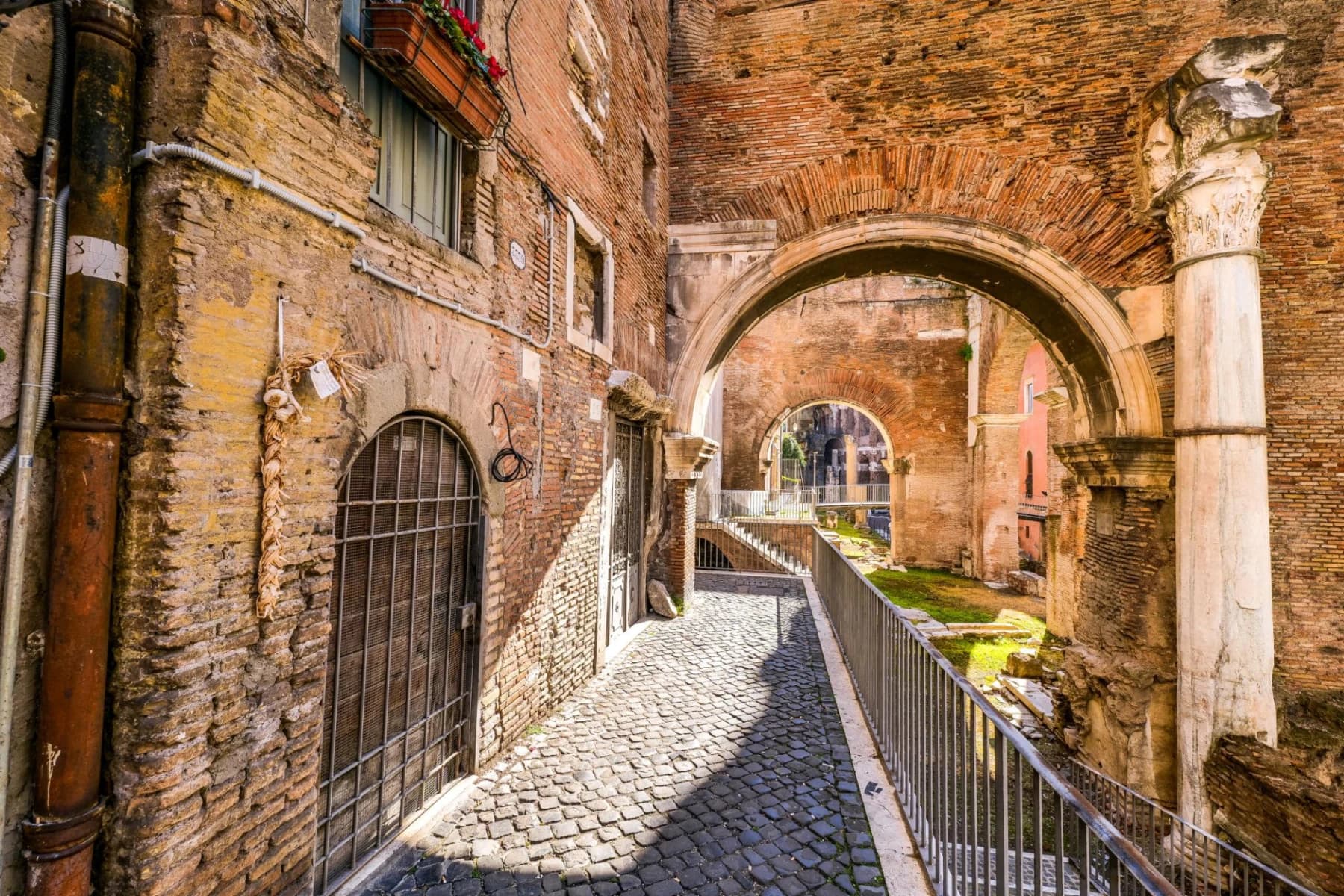
The Portico d'Ottavia is the physical anchor of the neighborhood. Built by Augustus in the first century BCE and dedicated to his sister Octavia, it was originally a columned entrance to twin temples and one of Rome's most significant public libraries, which held both Greek and Latin manuscripts.
What you see today is an archway absorbed into the medieval fabric around it. A church, Sant'Angelo in Pescheria, was built directly into the ruins during the Middle Ages. For centuries the portico served as a covered fish market, which is how the surrounding streets acquired names like Via della Pescheria. Fishmongers were required by law to give the heads of large fish to the local canons as a kind of tax.
Stand in front of the arch and look down. The current street level sits well above the ancient ground level. The column bases are underground. Rome has been burying itself in its own rubble for two millennia, and here you can see it clearly.
Teatro di Marcello
Two minutes from the Portico, the Teatro di Marcello looks, at first glance, like a smaller and less famous Colosseum. The resemblance is not accidental: the Colosseum's architects used this theater as a partial structural model. Julius Caesar began the project; Augustus completed it around 13 BCE and named it after his nephew Marcellus, who died young before the opening.
The theater originally held between 11,000 and 20,000 spectators for plays, music, and dance. By the Middle Ages it had been converted into a fortress, then a palazzo. Look at the upper floors: private apartments sit up there today, occupied by some of Rome's oldest families. Concerts are held in the courtyard during summer. If you are in Rome in June or July, the schedule is worth checking.
The Great Synagogue
The Great Synagogue (Tempio Maggiore di Roma) was completed in 1904, thirty-four years after Italian unification granted the Jewish community full citizenship. It is built in an Assyrian-Babylonian style that was deliberately chosen to distinguish it visually from the churches surrounding it. The square aluminum dome is its most recognizable feature from a distance.
Access to the interior is through the Jewish Museum. Entry to the museum includes entry to the synagogue itself. Security at the entrance involves a bag check and a brief wait. This is standard for Jewish institutions in European cities and moves efficiently.
Jewish Museum of Rome
The Jewish Museum sits in the lower level of the Great Synagogue and covers roughly 2,200 years of Jewish life in Rome. The collection includes ceremonial silverware, Torah mantles, marble inscriptions, and illuminated manuscripts. There is a section on the 1943 deportation that is quietly devastating.
Start here if you want historical grounding before walking the neighborhood, or if you are visiting with children. Admission is approximately €12 for adults and includes the synagogue. Closed on Saturday (Shabbat) and Jewish holidays.
Fontana delle Tartarughe
In the Piazza Mattei, a small square five minutes from the Portico, there is a late Renaissance fountain that most Rome visitors never find. Four bronze youths, each standing on a dolphin, help four tortoises climb over the lip of the upper basin. The tortoises were added in the seventeenth century.
The fountain was built in the 1580s. The dolphin-and-youth figures are considered among the finest examples of Mannerist bronze work in Rome. The piazza is easy to miss and entirely worth the small detour.
The Stolpersteine
On the paving stones outside several buildings along Via del Portico d'Ottavia and nearby streets, small brass plaques are set into the ground. These are Stolpersteine, or stumbling stones, part of a Europe-wide project by German artist Gunter Demnig. Each one marks the last known address of a person deported and killed during the Holocaust, bearing their name, date of birth, date of deportation, and fate.
There are hundreds in Rome. In the Jewish Quarter, the concentration is high. Take a moment to read a few.
Fitting this into your Rome trip?
The Jewish Quarter works well as a morning visit combined with Campo de' Fiori and the Pantheon. A structured itinerary helps you pace these areas without backtracking or losing time.
See Rome ItinerariesWhat to eat
Roman-Jewish cuisine is one of the most distinctive cooking traditions in Italy, and the Jewish Quarter is where it is most faithfully practiced. The tradition developed over centuries of poverty and restriction: the dishes use inexpensive cuts, vegetable scraps, and frying as both a preservation and a cooking method. The results are some of the best things you can eat in Rome. For a broader look at where Romans actually eat, see the Rome restaurants guide.
Carciofi alla giudia
Jewish-style artichokes are the defining dish of the neighborhood. A whole artichoke is flattened, pressed into a flower shape, and deep-fried twice: once to cook it through, once to crisp every leaf. The exterior is shatteringly crunchy; the heart is soft and slightly bitter. You eat the entire thing. Artichokes are at their best from February through May. Outside that window, ask the kitchen whether they are fresh or frozen before ordering.
Fiori di zucca
Zucchini blossoms filled with fresh mozzarella and a single anchovy fillet, fried in a light batter. The salt of the anchovy against the delicate flower is precise. These appear on menus across Rome, but the versions in the Jewish Quarter are generally the standard by which others are measured.
Baccalà fritto
Fried salt cod in a thick, airy batter. It is not a complex dish and does not need to be. Order it as a starter and eat it immediately, before it cools.
Torta di ricotta e visciole
The kosher bakeries on Via del Portico d'Ottavia sell a dense ricotta and sour cherry tart that is specific to Roman-Jewish pastry tradition. Buy a slice to eat on a bench near the Fontana delle Tartarughe. It travels well for an afternoon.
Where to eat
Nonna Betta and Ba'Ghetto on Via del Portico d'Ottavia are the most well-known and reliably good. For something more local in feel, Sora Margherita in the small Piazza delle Cinque Scole has no sign on the door, a handwritten menu, and a lunch-only service that often runs out of food by 2pm. Cash only.
When to go and how to get there
Friday morning is the best time to visit. The streets are quieter than at the weekend, the bakeries are stocked for Shabbat, and there is a particular energy to the neighborhood in the hours before the Jewish Sabbath. Saturday is not a good day if you want to enter the synagogue or museum, both of which are closed.
Avoid the hour between 1pm and 3pm in summer. The narrow streets hold heat and the restaurants fill with long queues. Go early or after 3:30pm.
From Campo de' Fiori, walk south along Via dei Giubbonari and cross Largo dei Librari. Five minutes. From Piazza Venezia, walk along Via del Teatro di Marcello toward the river. Eight minutes. By public transport, Tram 8 stops at Largo di Torre Argentina, which is a three-minute walk. Bus lines 40, 46, 62, and 64 stop near Piazza Venezia.
The neighborhood pairs well with a morning at Campo de' Fiori (market open until 2pm) and the Pantheon in the afternoon, twelve minutes on foot from the Portico.
Frequently asked questions
Is the Jewish Quarter worth visiting in Rome?
Yes, especially if you have been to Rome before and want something beyond the major monuments. The neighborhood is compact, historically dense, and offers food that you will not find anywhere else in the city. It works as a two-hour dedicated visit or as part of a full day in the historic center.
What is the difference between the Jewish Quarter and the Jewish Ghetto?
They refer to the same neighborhood. Ghetto is historically accurate: it was a walled, mandatory enclosure established in 1555 by papal decree. Many people in the community today prefer the term Jewish Quarter as less freighted. Both are in common use and neither is incorrect.
Can I visit the Great Synagogue without a guided tour?
Yes. Entry to the Great Synagogue is included with a Jewish Museum ticket and you can visit independently. The museum offers guided visits in English on certain days. Check their schedule before arrival as it shifts seasonally and closes on Jewish holidays.
What should I eat in the Jewish Quarter?
Start with carciofi alla giudia if artichokes are in season (February through May). Add fiori di zucca and baccalà fritto. For dessert, the kosher bakeries on Via del Portico d'Ottavia sell ricotta and sour cherry tart worth buying to eat on a nearby bench. A full meal at a sit-down restaurant runs €25 to €40 per person including wine.
When is the Jewish Museum closed?
The museum is closed on Saturday (Shabbat) and on Jewish holidays. General hours are Sunday to Thursday 10am to 6pm, Friday 10am to 4pm, though these shift seasonally. Confirm on their website before visiting.
Related reading
- Where to Stay in Rome: Neighborhoods by Type of Traveler
- The Rome Reservations Guide: What to Book and How Far Ahead
- First Time in Rome: Complete Planning Guide
Related Services
Ways we can help with this trip
Personalized itineraries
Day-by-day Rome plans built around timing, geography, and the way you actually travel.
Explore itineraries→Experiences
Cooking classes, evenings, day trips, and concierge-style add-ons that fit around your trip.
See experiences→Airport transfer
Fixed-rate pickup from FCO or Ciampino with meet and greet inside arrivals.
Book airport transfer→Stay in Testaccio
A two-bedroom apartment in Testaccio for travelers who want a local base without losing city access.
View the Testaccio stay→